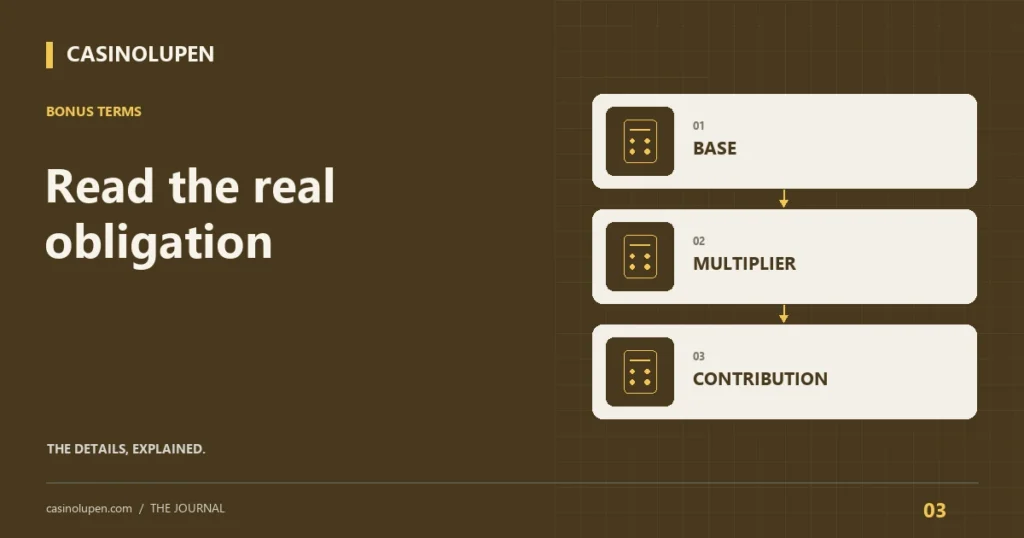
A wagering requirement describes how much qualifying play an offer demands before particular funds can become withdrawable under its terms. The headline multiplier is incomplete on its own. To calculate the obligation, you must identify the amount being multiplied and the proportion of each eligible stake that counts towards the target.
Even a correct calculation does not establish that the offer is worthwhile, affordable or possible to complete with the available balance. Games produce uncertain outcomes, and the balance can run out before the required play is reached. Treat the calculation as a way to understand a condition, not as a plan for recovering money.
First identify the calculation base
Two common descriptions are bonus-only wagering and deposit-plus-bonus wagering. They can produce different targets even when the bonus and multiplier are identical. Read the complete sentence in the actual offer. If the terms use an undefined expression such as “qualifying amount,” ask what is included before accepting the promotion.
Consider a hypothetical deposit of 60 units and a bonus of 40 units, both denominated in the same currency. At ten-times bonus-only wagering, the target is 40 × 10 = 400 units of qualifying stakes. At ten-times deposit-plus-bonus wagering, it is (60 + 40) × 10 = 1,000 units. These are illustrative calculations, not current offers from a named casino.
| Hypothetical rule | Base | Multiplier | Qualifying target |
|---|---|---|---|
| Bonus only | 40 units | 10× | 400 units |
| Deposit plus bonus | 100 units | 10× | 1,000 units |
| Bonus only, half already completed | 40 units | 10× | 200 units remaining from the original 400 |
Do not add the deposit twice. The calculator below asks for the bonus and, separately, any deposit included in the wagering base. Enter zero in the included-deposit field for a bonus-only calculation. Use the same currency for both fields.
Then apply the game contribution
A contribution percentage describes how much qualifying progress a stake earns. If an eligible game contributes 100%, a ten-unit stake adds ten units towards the target. At 50%, that stake adds five. At 10%, it adds one. A game that contributes nothing cannot complete the obligation through continued play.
The simple formula is total stakes required = qualifying target ÷ contribution as a decimal. A 400-unit target with a 50% contribution therefore corresponds to 800 units in stakes, assuming the rate stays constant and every stake satisfies the other conditions. At a 25% contribution, the same target corresponds to 1,600 units.
Mixed play requires a running ledger rather than one fixed percentage. If 100 units are staked at a 100% contribution and 200 units at a 50% contribution, the qualifying progress is 100 + 100 = 200 units. The total staked is 300 units. Confusing these totals is a common reason a progress bar appears lower than expected.
Turnover is not a deposit or a guaranteed loss
Turnover counts stakes, including funds that may be returned and staked again. It is not necessarily the amount deposited. Equally, it is not a promise that a smaller starting balance will last long enough to produce the required turnover. A succession of losing rounds can exhaust the balance early.
For a simplified mathematical illustration, a game with a theoretical 4% house edge and 800 units of turnover has an expected loss of 32 units under the assumed model. That expected value is an average across the model’s possible outcomes, not a forecast for one person. Real results can differ sharply, and bonus restrictions can change which play is permitted.
Do not subtract that expected loss from a bonus and label the difference a guaranteed return. Such a shortcut ignores the distribution of outcomes, the risk of losing the playable balance, withdrawal restrictions and the exact game rules. An obligation calculator cannot value every consequence of accepting an offer.
Read the conditions outside the multiplier
The maximum bet may apply per round, per spin, across simultaneous wagers or in a way defined specifically for feature purchases. The eligible-game list can be narrower than the casino’s general catalogue. A deadline may start at activation rather than the first wager. Each detail can matter even after the turnover arithmetic is correct.
Check what happens if the bonus is cancelled, if a withdrawal is requested while it is active, or if a cash balance and restricted balance coexist. The order in which balances are used can affect the account ledger. Avoid guessing from the colour of a wallet display; find the rule that explains the balance treatment.
A cashout cap is another independent condition. Completing the wagering target does not, by itself, remove a stated ceiling on bonus-related withdrawals. Record both the target and any cap on your comparison sheet so that a large displayed balance is not mistaken for an unrestricted withdrawal amount.
Keep jurisdiction-specific rules in context
Promotional rules are not uniform worldwide. The Gambling Commission’s published changes for Great Britain introduced a ten-times cap on bonus wagering requirements from 19 January 2026. That source concerns businesses subject to its rules; it should not be presented as a global description of every website accepting cryptocurrency.
When comparing an actual offer, establish the account’s applicable terms and jurisdiction first. A number copied from an old review may reflect an earlier promotion or a different market. The date and scope of the evidence matter as much as the arithmetic.
Reconcile the progress without increasing the risk
If the progress shown in an account does not match your calculation, stop and inspect the ledger. Save the offer terms, eligible game name and version, round IDs, stake amounts and timestamps. Work through a few identifiable rounds rather than trying to infer the rule from a total balance movement.
Ask support which contribution rate was applied to those rounds and which clause explains it. A useful response should resolve the specific difference. Do not place more bets merely to test an unexplained restriction. Further play can make the record harder to reconcile and exposes more money to loss.
A clear calculation can support a decision to decline
The final comparison should contain the base, multiplier, contribution, qualifying target, deadline, maximum bet and cashout treatment. If any of these remain ambiguous, the offer is not fully understood. There is no requirement to accept a promotion simply because it appears during registration or deposit.
Use the calculator as a reading aid and keep its assumptions visible. If completing the target would require more time or money than you intended, that is a reason to decline, not to raise your limits. Gambling is not a dependable income method, and a promotional deadline should never override an affordability boundary.
What does the wagering figure mean?
Use the offer’s own terms. This calculates turnover, not a recommended spend or a prediction of profit.
Turnover = (bonus + included deposit) × multiple ÷ (contribution ÷ 100). A 0% contribution cannot complete wagering. Units follow your inputs; no live exchange rates.CHECK THE ORIGINALS
Sources & further reading
- Gambling Commission — safer and simpler gambling promotions ↗
- Gambling Commission — return to player ↗
Sources reviewed . Terms and availability can change. Check the relevant source before making a decision.
Suggest a correction