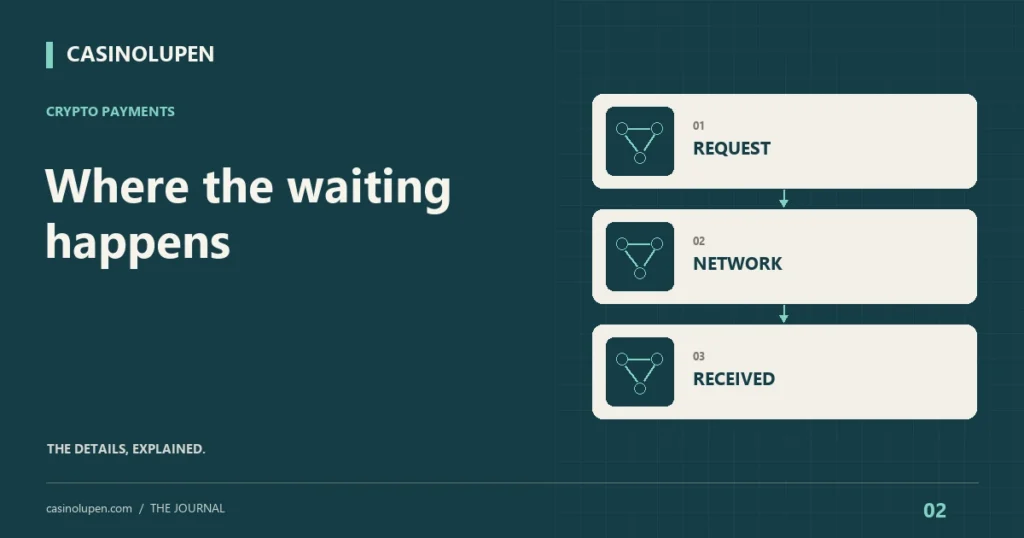
A crypto casino withdrawal has at least two clocks: the time a business takes to release the payment and the time the receiving system takes to recognise it. A claim about one clock should not be read as a promise about the other. Until the transfer has actually been sent, looking at a blockchain’s typical speed will not explain an operator’s internal delay.
The most useful question is therefore not simply “how long do crypto withdrawals take?” It is “which stage has my request reached, and what evidence establishes that?” This guide separates the stages, explains the records worth keeping and shows how to ask a support question that can produce an actionable answer.
The four stages of a withdrawal
First, a request is created in the casino account. Second, the operator applies its stated checks and payment procedures. Third, it submits a transfer using the chosen payment route. Fourth, the receiving wallet or service displays the funds according to its own recognition rules. A label such as pending, processing or completed may describe different stages on different websites.
| Stage | Record to look for | What it does not establish |
|---|---|---|
| Request created | Request ID, amount, network and timestamp | That the payment has been sent |
| Internal review | Specific request for information or processing explanation | A blockchain confirmation time |
| Transfer submitted | Transaction identifier on the stated network | That the receiving service has credited it |
| Funds received | Wallet or receiving-account entry | That every future withdrawal will behave identically |
Keep the asset and network beside every timestamp. A Bitcoin transaction and a token transfer on another chain cannot be investigated with the same explorer merely because both were requested from the same account. The exact route is part of the evidence.
Read the operator’s processing window literally
A published processing window may begin when a request is made, when verification is complete or when a payment is approved. Those starting points are materially different. Check whether the wording refers to business hours, calendar days or a maximum review period, and whether additional checks are described separately.
Consider a hypothetical request submitted at 18:00 on Monday, approved at 10:00 on Tuesday and received at 10:08. The blockchain portion may have been short, but the overall wait was sixteen hours and eight minutes. Calling that an eight-minute withdrawal would omit the stage that mattered most to the customer. This is a constructed example, not a measured casino result.
Do not assume that cancelling and recreating a request preserves its place in a queue. It may create a new request with a new timestamp or different conditions. Before changing anything, ask what the cancellation would do and retain the original record. Avoid returning withdrawn funds to play while waiting for an explanation.
Why network timing is not a countdown
After submission, network conditions and the receiving service’s rules become relevant. For Bitcoin, Bitcoin.org explains that block discovery is probabilistic; the approximate ten-minute average is not a guaranteed interval for an individual confirmation. Fee prioritisation can also affect when an unconfirmed transaction is included.
A receiver may require more than the first confirmation before updating an account balance. That requirement belongs to the receiving service, not to a universal rule applying to every casino or wallet. Read the current deposit instructions at the destination. A visible transaction can be real while the destination still waits to credit it.
Other networks use different mechanisms and terminology. Do not translate “six confirmations” from one network into six minutes on another. The practical investigation remains the same: establish that the correct network was used, inspect the transaction status and compare it with the destination’s stated requirements.
Where verification fits into the timeline
Identity or financial-information requests can be part of an operator’s account procedures, but their existence should not become a catch-all explanation for every delay. Ask exactly what is outstanding, when it was requested and where it should be submitted. A vague answer that repeats “security checks” without addressing a specific missing item is not a useful status update.
Rules vary by jurisdiction. For Great Britain, the Gambling Commission’s verification guidance distinguishes checks that could have been requested earlier from information needed to meet obligations arising later. This is a jurisdiction-specific reference, not a promise about every internationally accessible operator.
Never publish verification documents in an open forum to prove that you supplied them. Record the submission date, the channel and the operator’s acknowledgement privately. When sharing a complaint summary, redact document numbers, addresses and account identifiers that are not necessary for the recipient.
Check the amount as well as the time
A withdrawal is not fully reconciled until its amount makes sense. Compare the requested amount, any stated deduction and the amount received in the same asset. If the destination converts the transfer into another currency, preserve that conversion as a separate step. Otherwise a price movement can look like a missing payment.
For example, a hypothetical fixed charge of two units on a forty-unit withdrawal equals 5% of the requested amount. On a two-hundred-unit withdrawal it equals 1%. This comparison explains the effect of a fee; it is not a reason to deposit more, gamble longer or keep money with an operator. The calculator below uses the same straightforward ratio.
Send a support message that identifies the stage
A concise enquiry should include the request ID, request timestamp with time zone, asset, network, amount and the account’s current status. Then ask one stage-specific question: has the payment been submitted, and if so, what is the transaction identifier? If it has not, ask which stated processing step remains incomplete.
Do not send a seed phrase, private key or one-time login code. None is needed to inspect a public blockchain transaction. Be cautious if an unsolicited responder offers to accelerate a withdrawal through a separate wallet connection or an additional transfer. Verify the support channel from the website you independently intended to use.
Keep replies in order. A timeline with four dated events is easier to investigate than a large collection of cropped screenshots without context. Preserve complete original records privately, while sharing only the relevant excerpts in the complaint itself.
Escalate a delay without inventing a deadline
Compare the actual wait with the operator’s written terms and the circumstances of the request. If the stated window has passed, explain that discrepancy explicitly and ask for a written response through the formal complaints process. Check which regulator or dispute-resolution body, if any, has authority over the account before sending documents elsewhere.
CasinoLupen cannot trace private account activity or release a payment. We also do not assign a universal “normal” withdrawal time to every operator and network. The reliable approach is to identify the stage, preserve the evidence and use the applicable complaint route. If a service demands another deposit to release existing funds, stop and verify the situation independently rather than treating the demand as a standard fee.
Put the fee in proportion
Compare a fixed transfer cost with the amount being sent. Enter both figures in the same currency or token.
Fee share = fees ÷ transfer amount × 100. Fees may be charged on top or deducted; this tool does not assume which.CHECK THE ORIGINALS
Sources & further reading
- Bitcoin.org — confirmations and transaction timing ↗
- Gambling Commission — age, ID and financial verification ↗
Sources reviewed . Terms and availability can change. Check the relevant source before making a decision.
Suggest a correction