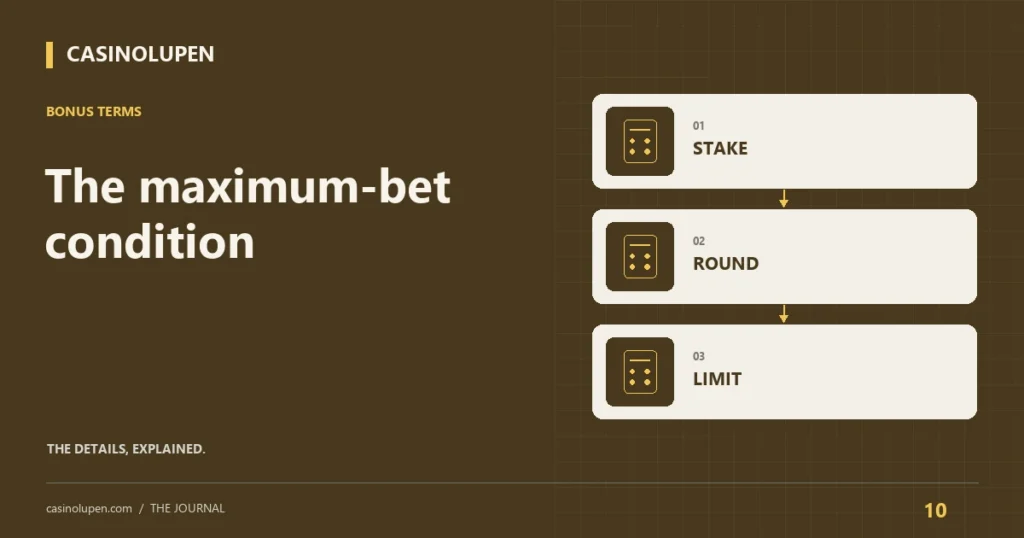
A maximum-bet condition limits the size of a wager permitted while a casino promotion is active. It can sit far below a game’s ordinary table limit. A stake accepted by the game interface may therefore still raise a separate question under the bonus terms.
Before accepting an offer, identify the exact limit, the unit it uses and the activity it covers. A rule expressed “per spin” is not necessarily identical to one expressed “per round” or “across simultaneous bets.” This article explains how to read the condition without assuming that every operator defines those terms in the same way.
The game limit and the promotional limit are separate
A game may allow stakes from one to one hundred units under its normal rules. A hypothetical bonus could impose a five-unit maximum while restricted funds are active. The larger interface limit does not automatically override the promotional condition. Both sets of rules need to be understood together.
Conversely, a bonus limit does not prove that every stake below it qualifies. Eligible-game restrictions, contribution rates and other conditions can still apply. Think of the maximum bet as one boundary in a larger rule set rather than a complete definition of compliant play.
If the interface and terms appear inconsistent, ask support to clarify before placing a wager. Preserve the answer and the version of the terms you read. A vague reassurance that “the game will not let you do anything wrong” does not explain how a specific written condition is enforced.
Identify the unit of the limit
Record whether the rule uses a currency amount, a percentage of the bonus or another formula. If it uses a currency different from the account’s displayed denomination, find the conversion rule. Do not substitute a current exchange rate from an unrelated website unless the terms explicitly use that reference.
Suppose an illustrative condition limits a stake to the lower of five units or 10% of the original bonus. For a thirty-unit bonus, the resulting limit would be three units. For an eighty-unit bonus, it would be five. This is only an example of reading a compound condition, not a description of an actual offer.
| Wording | Question to resolve |
|---|---|
| Per spin | Does the amount include optional stake enhancements? |
| Per round | How does the game define the complete round? |
| Simultaneous bets | Are several wagers combined for the limit? |
| Percentage of bonus | Does “bonus” mean original or current restricted funds? |
| Currency equivalent | Which conversion rate and timing apply? |
Feature purchases can change the relevant amount
A slot’s displayed base stake may differ from the price of an optional feature purchase. If a feature costs fifty times a one-unit base stake, the purchase costs fifty units. You cannot assume that a one-unit display makes the purchase a one-unit wager for promotional purposes.
Read whether feature purchases are allowed at all while the promotion is active. If they are permitted, check how the cost is counted. A restriction may concern the purchase price, underlying stake, feature mode or a separate exclusion. The exact wording determines which question needs answering.
The same caution applies to additional wagers or stake-boosting options. A button described as an enhancement may change the total amount committed. Review the final stake summary rather than relying on the last base value you remember selecting.
Several table wagers may create one combined exposure
In a table game, the screen can contain a main wager and one or more optional side bets. A promotional rule may assess them separately or combine them within a round. Do not assume that each visible chip stack receives an independent maximum simply because the interface separates it.
For illustration, a three-unit main wager plus two side bets of two units each creates seven units of total stakes for that round. Whether a five-unit promotional limit is breached depends on the rule’s definition. The arithmetic establishes the total; it does not decide the contractual interpretation.
If the terms are unclear, ask a specific question using the hypothetical amounts and wager types. Avoid placing the combination to “see what happens.” A later dispute is harder to resolve than an unanswered pre-play question.
Check when the condition starts and ends
A bonus maximum may apply while a promotion is active, while restricted funds remain, or during a defined wagering period. These descriptions can have different consequences. Do not infer the end point solely from a balance reaching zero or from the progress bar appearing complete.
Find out what the account must show before the promotional restriction is removed. If cancelling a bonus changes the status, read the cancellation consequences first. It may affect restricted funds or associated winnings under the terms. A general article cannot promise that cancellation preserves every displayed amount.
Keep cash and restricted balances distinct in your notes. The order in which the operator uses those balances can affect the scope of a condition, but it must be established from the actual rules rather than guessed from the account’s layout.
Reconstruct a disputed wager carefully
If an operator says a maximum-bet condition was breached, request the relevant round IDs, stake amounts and clause. Compare those records with the accepted offer and the game’s own round structure. A useful review needs identifiable events, not only a statement that the overall balance was reduced.
Create a short ledger with the date, time zone, game version, main stake, optional stakes and total round cost. Note whether the round settled, was cancelled or was adjusted. Preserve the original evidence privately and share only the material relevant to the complaint.
Do not alter screenshots or omit a side wager because it weakens your interpretation. A factual record makes it easier to distinguish a calculation error, a misunderstood term and an unexplained operator decision.
Maximum bet and contribution are not substitutes
Reducing a stake does not necessarily increase its contribution percentage, and a fully contributing game does not waive a maximum-bet rule. These are different inputs. The game contribution guide explains how qualifying progress is calculated, while our wagering guide explains the target itself.
Use those calculations to understand the commitment rather than to design a completion system. Even permitted stakes can lose the entire available balance. A maximum-bet rule describes a contractual ceiling, not a recommended or affordable wager.
A clear condition can still be a reason to decline
A promotion may require more attention, time or exposure than you intended. Understanding the terms does not oblige you to accept them. If the conditions are ambiguous, ask first; if they remain unsuitable, decline rather than stretching your spending or session limits.
For market-specific standards, consult the relevant regulator’s current guidance. The Gambling Commission’s marketing provisions provide one jurisdictional reference, not a global rulebook. The practical task is always to read the actual offer, preserve the evidence and keep its limitations visible.
What does the wagering figure mean?
Use the offer’s own terms. This calculates turnover, not a recommended spend or a prediction of profit.
Turnover = (bonus + included deposit) × multiple ÷ (contribution ÷ 100). A 0% contribution cannot complete wagering. Units follow your inputs; no live exchange rates.CHECK THE ORIGINALS
Sources & further reading
Sources reviewed . Terms and availability can change. Check the relevant source before making a decision.
Suggest a correction