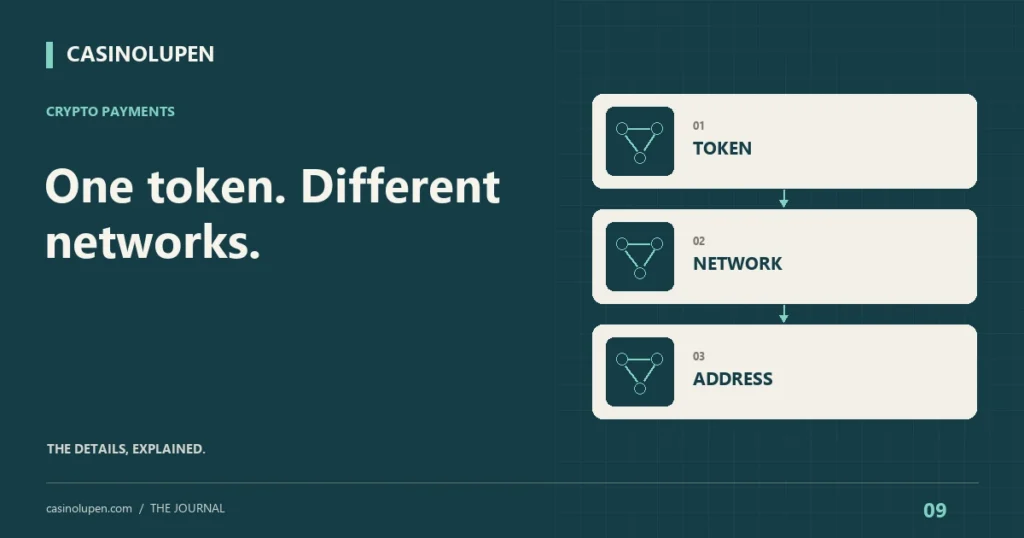
USDT is a token name, not a complete payment instruction. Before a USDT transfer, the sending and receiving services must agree on the supported network and asset. Choosing a route solely because it has the lowest displayed fee can turn a small saving into a payment the receiver cannot credit.
This guide explains how to read those instructions. It does not recommend a casino, network or transfer amount. The decision to use a gambling service requires separate checks of eligibility, the operator and its terms; a technically valid payment route does not answer those questions.
Separate the token from the network
Tether’s official protocol information describes its tokens across multiple blockchains and provides network-specific identifiers. That is why a token symbol alone is insufficient. A service may support USDT on one network while not supporting it on another.
Read the destination’s deposit screen first. Record the exact asset and network wording, then check whether the sending service offers that same route. Similar labels can be confusing, so resolve any ambiguity through the services’ verified documentation or support before authorising a payment.
A familiar address format is not a substitute for network matching. Some networks can use addresses that look alike while maintaining separate transaction histories. Copying the right-looking characters into a sending form does not prove that the receiver will recognise the chosen route.
Make three matches before authorising
| Match | Compare | Common mistaken assumption |
|---|---|---|
| Asset | Exact supported token, including any relevant contract identifier | Every token with the same symbol is identical |
| Network | Sender’s withdrawal route and receiver’s deposit route | A cheaper network is interchangeable |
| Destination | Current receiving instructions and final confirmation screen | An old saved address is always sufficient |
If the receiver requires an additional tag, memo or other reference, treat it as part of the destination instructions. Do not assume that such a reference is always required or never required for a token simply because a previous service behaved differently.
Check the final confirmation screen, not only the address copied earlier. Clipboard substitutions, stale saved recipients and a changed network selection can create a mismatch between what you intended and what the wallet is about to send.
Understand which fee is being quoted
A custodial exchange may display a withdrawal charge in USDT. A self-custody wallet may instead require the network’s fee asset to pay for a token transfer. The details depend on the network and wallet. Do not assume that holding a token balance automatically supplies everything needed to submit it.
Separate charges paid on top of the amount from charges deducted from it. If a hypothetical transfer instruction is for 50 units and a two-unit fee is deducted, the receiving amount may be 48 units. If the fee is charged on top, the recipient can receive 50 while the sender spends 52. Read the actual interface to establish which model applies.
The fee-share calculator below uses fee divided by transfer amount. It does not infer whether the fee is deducted, added or paid in another asset. Convert amounts consistently before comparing them, and do not use the percentage as a reason to increase a gambling deposit.
Minimum credited amounts can change the result
A destination’s minimum deposit can refer to the amount received, not the amount entered before a sender’s deduction. A payment that falls below that threshold may not be handled as you expect. Read the stated consequence before sending, including whether smaller transfers are credited, held or subject to a manual process.
For a hypothetical fifty-unit credited minimum, a request that sends fifty units but deducts two would arrive below the threshold. The arithmetic is simple, but it shows why the sending amount and credited amount belong in separate columns of a payment note.
Do not assume that two smaller deposits will be combined to satisfy a minimum. The receiver may evaluate each transaction separately. If the rules do not say how multiple transfers are treated, ask before creating an avoidable reconciliation problem.
Check what the casino credits after receipt
Some account interfaces display a token balance, while others show a converted fiat-denominated balance. Identify the actual denomination of the ledger. A dollar-like display is not proof that the account holds US dollars, nor does it establish how a future withdrawal will be converted.
Record any exchange rate and conversion charge applied at crediting. A USDT transfer, a casino balance conversion and a later withdrawal conversion are distinct events. Keeping them separate makes it easier to identify whether a difference comes from a fee, a rate or an account rule.
A stablecoin’s target value also does not eliminate issuer, market, network or custody risks. Avoid describing a token-denominated gambling balance as equivalent to an insured bank deposit. The operator still controls its internal account process and the conditions under which funds are released.
Investigate a delay on the correct network
Use the transaction identifier supplied by the sender and an explorer for the selected network. Confirm the asset, destination and status. A transaction visible on one chain will not become visible on a different chain merely because both support tokens with the same name.
If the transfer has not been submitted, the sending service remains the starting point for an enquiry. If it is recorded on the correct network but the account has not credited it, compare the amount and destination’s confirmation requirements before contacting the receiver.
Send a concise report containing the transaction identifier, network, asset, amount, destination and relevant account reference. Do not send a recovery phrase or private key. Those secrets are not necessary to read a public transaction record.
If the route was wrong, stop and preserve evidence
A wrong-network transfer is not automatically recoverable, even if the destination address looks valid. Recovery depends on the technical situation and the receiving service’s capabilities and policies. No general article can promise that a support agent will retrieve it.
Contact the receiving service through its verified route and preserve the original instructions and transaction record. Do not send another deposit to an unsolicited “recovery” address. Do not connect a wallet to a tool offered by an unknown responder who claims it can reverse the transfer.
Repeat the check for every new payment instruction
Services can change supported routes, addresses, minimums or processing rules. A transfer that worked previously is useful history, but it is not a substitute for checking the current instructions. Review the details again when using a new account, a different network or a saved recipient after a long interval.
The practical sequence is simple: establish the legitimate receiver, match the asset and network, verify the destination, understand the received amount and retain the record. If any part remains uncertain, pause before authorising. A payment cannot be made reliable by confidence alone.
Put the fee in proportion
Compare a fixed transfer cost with the amount being sent. Enter both figures in the same currency or token.
Fee share = fees ÷ transfer amount × 100. Fees may be charged on top or deducted; this tool does not assume which.CHECK THE ORIGINALS
Sources & further reading
- Tether — supported protocols and integration guidelines ↗
- Ethereum.org — security and scam prevention ↗
Sources reviewed . Terms and availability can change. Check the relevant source before making a decision.
Suggest a correction