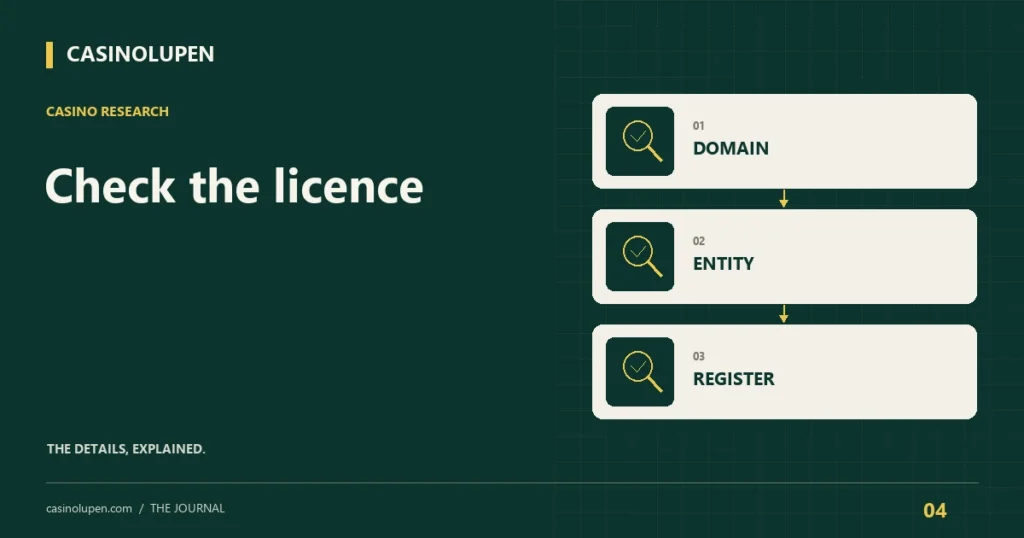
A licence badge is a starting point for a check, not the result of one. To verify an online casino licence, connect the exact website you are visiting to the legal entity named in its terms and then to a current record held by the relevant authority. Each connection needs evidence. A genuine-looking seal or a licence number copied into a footer is not enough.
This process does not establish that gambling is permitted for you in your location, nor does it guarantee a business’s future conduct. It answers a narrower question: what licence information can you substantiate about this service? Keeping that question precise prevents a limited check from turning into a broad and unsupported claim of safety.
Record the exact domain and contracting entity
Begin with the address visible in the browser, including any country-specific version. Then open the current terms and identify the company with which an account holder would contract. Record its name as written, any registration details provided and the date of the terms. Keep a copy of the relevant passage with its source address.
Brand names are not legal entities. A familiar brand may appear on several domains or be used by different companies in different markets. Conversely, one company may operate several brands. Neither arrangement is automatically suspicious, but it makes name matching more important. Do not stop at a search result that merely contains the same brand word.
A practical note might read: “Website A identifies Company B in its terms; the footer claims licence C.” This deliberately leaves the connection unconfirmed until the authority’s record supports it. Avoid upgrading “claims” to “holds” before completing the next check.
Reach the authority independently
Find the regulator’s official website through an independently verified address. A link in the operator’s footer can be convenient, but inspect its destination before relying on it. A lookalike verification page hosted on an unrelated domain may repeat an operator’s claims without being maintained by the authority it names.
The Gambling Commission describes its public registers as a source of licensing and regulatory information for its remit. Other jurisdictions use their own systems. The presence of a record in one system should not be interpreted as authorisation everywhere a website is accessible.
Search using more than one identifier when the register allows it: company name, trading name, website address and licence or account number. If a name produces several results, open the individual records. A result list can conceal distinctions that become obvious in the full entry.
Match the fields, not just the number
| Field | Why it matters | What to record |
|---|---|---|
| Legal entity | Identifies the business associated with the record | Exact name and any identifier |
| Website or trading name | Connects the record to the service being assessed | Exact listed domain or documented connection |
| Status | A historical record may still be searchable | Current status as displayed |
| Licensed activity | Different activities can have different permissions | Scope relevant to the service |
| Restrictions or regulatory action | Can qualify a simple “licensed” description | Linked notice and its date |
Do not silently ignore a mismatch. If the terms name one company while a seal opens a record for another, there may be an explanation, but it has not yet been established. Ask for the precise relationship and check it against the authority’s information rather than accepting a general reassurance.
Similarly, a software supplier’s licence is not automatically the licence of the business holding player funds. A testing certificate, company-registration document or membership logo answers a different question. Keep each document under the category it actually supports.
Read status and scope in context
A register can include inactive, expired, surrendered or otherwise historical records. Finding a company therefore does not end the check. Read the current status and any accompanying notes. If you encounter unfamiliar terminology, use the regulator’s explanation rather than translating it into “approved” based on how reassuring it sounds.
Scope matters in a similar way. A permission associated with one form of gambling or one business role may not establish permission for every product on a site. Describe only what the record shows. If the register does not list a domain and the connection cannot be verified elsewhere, preserve that uncertainty in your notes.
Time also matters. A saved record can document what was visible when you checked, but it cannot promise that the position will remain unchanged. For a later decision, revisit the original record. Do not infer current status from an old review that has changed its page date without showing new evidence.
Find the complaint route while reading the terms
Licensing research is more useful when it also identifies how an account holder could raise a dispute. Look for the operator’s formal complaints process, the information it requires and any applicable independent escalation route. The correct destination depends on the entity, service and jurisdiction involved.
For example, the Malta Gaming Authority’s player complaint page defines its own remit and submission process. Its existence does not mean it can handle a complaint about any casino mentioning Malta or accepting a particular cryptocurrency. Establish jurisdiction before sending personal information.
Save the route separately from everyday chat support. A chat transcript can help document a problem, but an operator may have a distinct formal procedure. Knowing that distinction in advance is more useful than searching for it after a payment dispute begins.
A hypothetical mismatch, worked through
Imagine that a website’s terms name Example Gaming A, while its footer links to a licence record for Example Services B. The names resemble each other, but the register lists no matching domain. The appropriate conclusion is “connection not verified,” not “licensed” and not an unsupported accusation of fraud.
A focused question would ask which entity contracts with account holders on that exact domain and where the authority records that relationship. If the response supplies a new document, inspect its issuer, date and scope. If it merely sends the same badge again, the original uncertainty remains.
This approach keeps the research fair to both the reader and the business. It avoids treating missing information as proof of wrongdoing while also refusing to treat a persuasive explanation as verified evidence.
What a successful check still leaves unanswered
A matching current licence record does not measure withdrawal speed, prove every game implementation, establish the quality of customer support or eliminate counterparty risk. Those questions require different evidence. Keep them separate in your casino comparison notes rather than allowing one positive finding to answer everything.
Finally, a website accepting your location is not a substitute for checking the rules that apply where you are. CasinoLupen does not provide individual legal advice or certify operators. If identity, scope or access rights remain unclear, leave the account unopened while you obtain a reliable answer. Verification is useful precisely because it can end in a decision not to proceed.
Your evidence checklist
Tick what you have checked. Completion records your review of the information; it does not rate or approve a casino.
Kept only in this open page. Nothing is sent to CasinoLupen or saved after reloading.CHECK THE ORIGINALS
Sources & further reading
Sources reviewed . Terms and availability can change. Check the relevant source before making a decision.
Suggest a correction